
POSTCARDS FROM ISTRIA – THE VILLAGE ON A DONKEY’S BACK, Leda Dobrinja
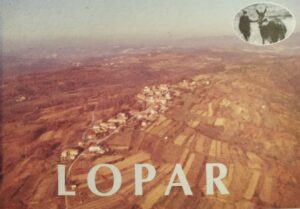
Be that as it may, one thing is certain: seen from afar, the shape of Lopar resembles a donkey’s back, a symbol that somehow demands our attention. The donkey is a beautiful and elegant animal, and we Istrians have always been particularly fond of it. We can hardly imagine our Šavrinke¹ without their donkeys. Nor, for that matter, our folk tales of orkoti and spirits, or the works of our contemporaries. The donkey has accompanied humankind through history and legend ever since Joseph fled Jerusalem with Mary. Its image is deeply rooted in popular thought and imagination, appearing as a metaphor in proverbs as well as in insults. Yet there is also a more intimate kind of memory, both personal and collective, attached to the events in which the donkey played its part.
Into our countryside, marked by the immovable weight of terraced earth and the harnessed ox, by meagre harvests and hardship, the donkey brings another dimension: movement, travel, trade and prosperity. And also liveliness and gentleness. As the witness to the Šavrinka’s journeys through the night, it awakens mystery and imagination as well.
What I first came to know was the immobility of life, the endlessly recurring fate of the farming family. Only later did I discover our connection with the town, with the life beyond our village, and our openness to the wider world. In some strange way, all of this is bound up with the donkey, which entered my earliest childhood together with my nona² Tonca.
All my happiest memories are connected with her and with my nonič³ Dolfo. Soon after I was born, they left Lopar, my native village, and moved to Paštoran near Koper. There they took over a small farm abandoned by a man from Koper named Argenti, who had left for Italy in the post-war exodus. He left them two small field houses, one to live in and the other for storing crops, together with three plots of land: a garden, a vala⁴ for growing tomatoes, and a distant field below the hill.
I myself grew up in Lopar. There, everything revolved around the cows: mowing, bringing in the hay, grazing and milking. Everything bore the stamp of heavy, cumbersome labour, even picking tomatoes and making the gruelling journey through swarms of horseflies to the cooperative. Whatever the cows and tomatoes earned went straight back into the farm.
My grandparents worked like ants, and their crops ripened early. Nona knew how to get a good price for them, and so they always brought money to us girls and to my father and helped us along. In those days Father might use it to buy another barrel or a plough. Some of our neighbours quietly envied us a little for that. Even the children knew how eagerly I awaited my grandparents, and they would tease my sister and me:
“Run, run! Nona from Paštoran is coming. She’s already down in the village with her muša!”⁵
And I would run down into the village to catch sight of that small, cheerful creature, my grandfather’s kindly smile, and his old-fashioned beret…
Every summer I spent a few days in Paštoran instead of dragging myself through the whole summer tending cattle on Brda and Brdine. It was there that I discovered what holidays were: swimming in the sea, Koper’s Kaligarija — and also the donkey. And it was there that I first saw my own village lying upon a donkey’s back.
Paštoran
Nona Tonca and nonič Dolfo were very good people, and through their kindness, quiet ways and tireless work they filled my childhood with some of its warmest memories. I remember the little flat spoon with which I ate paštokreme⁶, their cottage without electricity, and the garden.
If anyone wanted to conjure up in words a beautiful, abundant garden, they would have to describe my grandfather’s. The first cherries, grapes, peaches and figs. They would have to evoke its gently curving semicircular shape, bordered all around by a pergola, and the carefully tended vine trellis above the path that crossed the garden and led to a spring emerging from the living rock beneath a cherry tree. And in that garden, the earliest fruit: cherries before the first of May, grapes at the beginning of August, and before them the first breba figs.
Perhaps it was that miraculous garden and its abundance that made me spend the rest of my life searching for the quiet goodness of nonič Dolfo and the enchantment of his garden.
During those few summer days I also came to know the town and its illusions: the glitter of its shops, elegant ladies, friendly smiles, but also self-importance, loudness and greed. Out of the traces of those earliest memories, one particular incident emerges.
Noni, as I called him, was bent over the tomato plants down in the Vala when nona Tonca harnessed her muša, Mora, loaded the first figs onto the tavolac⁸, and off we went to the market in Koper. She sat me on the front edge of the flat cart, my legs dangling towards the wheels as they sank into the perpetually muddy road. She herself sat on the other side, and with an “eri, ke fa’ giorno!”⁹ we set off past the cooperative, across the dusty plain beside the canal near the fire station, and then along the avenue of poplars by the stadium.
She drove past Tapa and on beyond Fruktus, between some houses, until she stopped in a little square in front of a house where one of her regular customers, her ventora¹⁰, lived.
“Wait here and mind the figs,” she told me. “Buen, velej, velej.”¹¹
And so I waited with a child’s impatience, the minutes stretching endlessly, until some fantolini¹² began hanging around the muša and the cart and discovered what we were carrying.
“Figs! Figs!” they began shouting, calling the others over as though I were not there at all. Suddenly the cart was surrounded by a whole crowd of little rascals.
And they ate every last one of my figs.
Meanwhile nona Tonca, being who she was — hard of hearing and fond of a good chat — was inside doing business with the šjora.¹³ It was then that I first acquired a certain awe of the town, and a fear of those urban monsters. From that moment on, wariness of strangers, my father’s cunning and his kativerija¹⁴ seemed entirely justified.
Tonca Gives a Name to the Place She Loves
Every now and then nona Tonca would turn towards the hills in the southeast, point with her finger and say:
“Do you see it? Do you see that white line lying there like the back of a donkey? That’s Lopar.”
I began looking for that line myself, and ever since then I have searched for it whenever I look out from Koper, whenever I come down the Črni Kal slope from the interior, or approach from Trieste or from the hill above Trusok.1 And every time I find that gently hollowed curve of a donkey’s back.
And indeed, from a distance the village appears as a white chain stretched along a softly bending ridge, formed by a succession of pale houses. The donkey always faces the burja¹⁵, towards Slavnik in the east, while the houses look the other way, towards the southwest. As though everything were happening in a dream, and you were lying on top of a cart piled high with hay, gazing at the sky, closing your eyes and letting yourself be carried backwards, against the direction in which the cart was travelling.
In our parts, a female donkey was called a muša. My nona called her Mora that too, yet when she spoke tenderly of Lopar she used the image of the donkey itself. And although she remained as deeply in love with Lopar as she had been with Lazar, her first husband, she never abandoned her Kubed accent.
“Not vooosla,”¹⁶ she would correct us again and again. “Vuesla. Say it nicely, elegantly, so people won’t laugh at you.”
That was how she had learned to speak on her endless journeys to Trieste and through Istria, between Trieste and Koper. She was a woman from Kubed, a Šavrinkica¹⁷, who despite her poverty had earned enough to buy a donkey of her own by the age of sixteen.
There were not many Šavrinke, the women who traded in eggs, in Lopar. Only a handful who had married into the village from Kubed: Urša Fajčkovka and perhaps Tonca Kapovka. Nor were there many donkeys. One family, the Bardinčće, had owned a mule before they fell into poverty. The woman of the house did not harness it to an ordinary cart but to a karatina2 when she took milk to Trieste.
After the war, however, donkeys rapidly disappeared. In the village they were replaced by draught cattle, the slow and powerful Gardelini oxen that hauled carts and stacks of firewood out of the steep little woods.
The last muša belonged to Bepi Čjuda, and she too was called Mora. When he rebuilt his burnt-out house after the war, he kept her in a little stable on the ground floor, beneath his kambra.¹⁸ Since the two spaces were separated only by a floor of rough, untreated planks, even at night he knew what was happening with his muša. Through the cracks came the warm air of the stable, too, softening at least a little the icy cold of the room on winter nights.
He would harness the muša at the rear entrance of the house, sit his granddaughter Nada on the cart and say:
“Hold tight, Nada. We’re off.”
One day the young people left for Trieste, and the old ones eventually departed this world. The house and farm were left to whatever fate awaited them.
For a long time afterwards there was not a single donkey left in the village. Draught cattle, too, became fewer and fewer.
Yet people still say that someone is trmast ku vosu — stubborn as a donkey — and girls are still called muše when they behave improperly.
Riding the Donkey into the Future
Today there is once again a specimen of this beautiful animal in the village. Perhaps it is a Mori or a Nino — I do not know, for it is greyish in colour. Its owner is invited to bring it along to the farmers’ procession at the Refošk Festival in Marezige, and even to Koper, to Muda, for the Feast of St Lazarus in June.
Like the last surviving exhibit in a museum.
Yet to me, given our indifference towards our own past, all this seems more like mockery than genuine interest.
The owner still harnesses the donkey to his little wooden cart, though the old wheels, once rimmed with iron bands, have been replaced by car tyres. And so now, as it makes its way through the village, you no longer hear the grinding of wheels over the stone batuda.¹⁹ All that remains is the bright tick, tick, tick of slender hooves upon the faded asphalt. As though it were trying to avoid making a racket, trying not to attract the curious glances of the neighbours.
And so do I, hiding from people’s eyes in my new home in the Čjuda House,²⁰ gathering and binding together the fragile memories and remnants of the past. As though my grandfather’s enchanted garden had cast its spell upon me for all eternity, and the scorched walls themselves lent strength to that magic, I shyly try to uncover a magnificent past wrapped in mystery — a past worthy of the village’s mighty name, of Jeruf the martyr who was born here, and of the people of this settlement upon a donkey’s back.
Perhaps the people of this place are on horseback²¹ nowadays.
Perhaps the name Lopar really does derive from the word lopata, a shovel, and from the shovel-like shape of the hilltop. Yet just as, in times of trouble and supplication, they do not turn to their own Jeruf but jokingly send you off to svet’ (E)lija — St Elijah — so their terraced hill reminds them neither of a shovel nor of a horse.
Instead, it calls to mind the steady, undulating, gentle ride upon the back of an Istrian donkey.
Notes
1. Šavrinka. Šavrinija is a belt of land in north-western Istria, lying in the hinterland of the coastal towns of Koper, Izola and Piran on the Gulf of Trieste. Today the area is commonly known as Slovene Istria, although the name Šavrinija is also widely used. A Šavrinka, however, is more than simply a woman from Šavrinija. The word has become an almost mythical figure in local folklore, referring especially to the women who, during the last century and certainly earlier, travelled and traded between inland Istria and Trieste. Their image preserves the devotion, resilience and enterprise associated with this part of ancient Istria and with its native culture and language.
2. Nona. Nona, or nuona in Istrian speech, is the Istrian word for grandmother. Although it resembles the Italian nonna, nona is regarded locally as a traditional vernacular word used “since time immemorial.”
3. Noni / nonič. Noni, nonič, or in dialect pronunciation nuoni or nuonić, are traditional Istrian terms for grandfather. Like nuona, nuoni carries in itself a sense of tenderness and of the close bond between grandparents and grandchildren.
4. Vala. Both vala as a common noun and Vala as a field name refer to low-lying farmland in valleys at the foot of the hills. Because soil is deposited there by torrential rains, and because a stream often runs nearby, such places provide fertile fields and vineyards which, owing to their position, also withstand even the worst summer droughts relatively well.
5. Muša. A characteristic Istrian word for a female donkey, or jenny.
6. Paštokrema. Paštokrema or paštakrema is the local name for a custard cream slice. In the post-war years it was the treat most typically enjoyed by Istrian country people when they went into town.
7. Breba figs. The first figs of the year, ripening before the main crop; in the local dialect they are also called ocvetki.
8. Tavolac. A flat wooden platform fitted to a cart for carrying delicate seasonal produce packed in shallow crates. The crates were placed side by side, and a tavolac could hold around twenty or more of them.
9. “Eri, ke fa’ giorno!” “Eri, because day is breaking!” Eri! was the command given to donkeys to make them move off, as opposed to Šta!, which told them to stop. Different commands were used for cattle and horses.
10. Ventora. A regular customer who bought produce from a countrywoman selling her goods in town.
11. “Buen, velej, velej.” “I’ll be right back, right back.”
12. Fantolini. Town urchins or mischievous town boys.
13. Šjora. A dialect shortening of šinjora (Italian signora). The word was commonly used for a woman from town.
14. Kativerija. Kativerija — comparable to Italian cattiveria — appears, according to local interpretation, to derive from the old Slovene expression huda vera, “bad faith,” as opposed to good faith. Today the word is used mainly for malice or ill will. In my own surroundings, however, it was also used in a different sense: for wariness, shrewdness, or the ability to perceive and anticipate possible ill intent in one’s dealings with others.
15. Burja. The characteristically bitter, cold northerly wind of the northern Adriatic.
16. Vosu / vuoso. Vosu is the dialect word for donkey in the group of dialects spoken around Marezige; vosla is its genitive form. In the Rižana dialect group, to which the speech of Kubed belongs, the corresponding forms are vueso and, in the genitive, vuesla.
17. Šavrinkica. A diminutive of Šavrinka. It was used affectionately, almost as a term of endearment, by people in central Istria for the women from Šavrinija who came to trade with them. Today šavrinka is also a folkloric and literary designation for these women. They are known as jajčarice, “egg women,” and potovke, “travelling women,” because they were constantly on the road.
18. Kambra. An Istrian dialect form of kamra, meaning a room or chamber.
19. Batuda. The local dialect word for gravel or a gravelled road surface.
20. The Čjuda House. The Čjuda House — better known locally as Hiša od Čjuda — was the author’s home in the 1990s and a centre of the reawakening of the Istrian spirit in Slovene Istria. For more on this, see The Third Istrian Awakening and Its Shadows (Tretja istrska prebuja in njene senčine). Some people associated the name Čjuda with the Slovene words čudo or čudež, “wonder” or “miracle”; in fact, the house preserved the name of its first owners, members of the Čjuda family.
21. On horseback. The Slovene expression biti na konju, literally “to be on horseback,” means to have reached a safe or favourable position after overcoming difficulties.
————————————————-
1The local name for the village Truške.
2Kind of